An albatross, also called a double eagle, is a score of three strokes under par on a single hole. It’s extremely rare, typically the result of a hole-out second shot on a par-5.
Albatross continues the same bird theme: three under par is a genuinely rare feat, just as an albatross is a rare, oversized bird. The term appears to have caught on later than birdie and eagle. As late as 1935, Gene Sarazen described his famous three-under shot at the Masters as a “dodo” rather than an albatross, and “double eagle” remains the more common term in American usage even today.
Yes, a “condor” is a score of four strokes under par, achieved either with a hole-in-one on a par-5 or two strokes on a par-6. It’s so rare that it was once thought impossible: only a handful of condors have ever been verified worldwide, mostly on short, sharply dog-legged par-5s that allow a drive to cut the corner. There’s no standard name for anything better than a condor, and no standard name for a hole-in-one on any hole other than “ace.”
A birdie is a score of one stroke under par on a hole. On a par-5, that means finishing the hole in 4 strokes.
Birdie traces back to American slang: in the late 1800s, calling something “a bird” meant it was excellent. The most-cited origin story comes from the Atlantic City Country Club, where in the late 1890s a golfer named Ab Smith described his approach shot, which finished inches from the hole, as “a bird of a shot,” then proposed that anyone who won a hole in one-under-par should collect double money. He made the putt, and the group began calling that kind of score a “birdie.”
Par is the score an expert golfer is expected to take on a hole, always assuming two putts once they reach the green. A standard 18-hole course totals par 72, usually made up of four par-3s, ten par-4s, and four par-5s, though the exact mix varies by course.
Par is borrowed from the stock exchange, where a share trades “at par” when it’s at its normal value. In 1870, golf writer A.H. Doleman asked two professionals what a perfect score should be for the Prestwick links, and the figure they gave him became known as “par for Prestwick.”
The idea only became standardized decades later: the US Golf Association set the modern yardage bands for par-3, par-4, and par-5 holes in 1911, and Britain’s national handicapping bodies followed a similar path through the early 20th century.
Shooting “level par” for a round means a golfer’s total score matches the course’s total par, a benchmark generally only reached by scratch golfers (handicap of 0) or better. A golfer’s handicap is effectively the number of strokes they’re expected to shoot over par on average, which is why “par” is the fixed reference point every other scoring term (birdie, bogey, eagle) is measured against.
A bogey is a score of one stroke over par on a hole. On a par-4, that means finishing the hole in 5 strokes. Beyond triple bogey (three over), there’s no widely used name for higher scores: a “quadruple bogey” is technically correct, but many golfers just call anything three-or-more over par a “blow-up hole” or “disaster hole.”
Bogey didn’t start out meaning “one over par,” it meant something closer to today’s par. In 1890, an English club secretary began standardizing the expected score at each hole, calling it the “ground score.” At Great Yarmouth Golf Club, a player who couldn’t beat that target was said to be playing against an invisible, ever-par opponent nicknamed “the Bogey Man,” after a popular music hall song of the era. The nickname stuck, and it’s also where “Colonel Bogey” comes from: at a services club where every member held a military rank, the honorary opponent was given the rank of Colonel rather than the informal “Mister.”
Once the Americans developed the separate concept of “par” using standardized yardages, they repurposed “bogey” to mean one shot worse than that new par, and that’s the meaning that stuck internationally.
It depends on the golfer. For a scratch or professional player, a bogey is a dropped shot , and even top PGA Tour pros average around 2-3 bogeys per round in top-level events. For recreational golfers, bogeys are routine and often something to aim for: golfers in the 16-20 handicap range average around 7 bogeys per 18-hole round, alongside roughly 5 double bogeys and 2 triple-or-worse. A golfer who reliably makes bogey on most holes (averaging roughly 85-95 for 18 holes) is described as playing “bogey golf” , a realistic, achievable target rather than a discouraging label.
An eagle is a score of two strokes under par on a hole. On a par-5, that means finishing the hole in 3 strokes.
Eagle follows on naturally from birdie: once “birdie” meant a great score, a still-better score needed a bigger bird, and American golfers reached for their national symbol. The same Atlantic City group credited with coining “birdie” also used “eagle” for a two-under score.
Championship course is one of the most overused terms in golf. It once meant a course worthy of hosting an actual championship. Today it is applied to almost any 18-hole course with a minimum par of 66, which covers roughly 98% of golf courses, so the label alone says very little about a course’s actual difficulty or prestige. It’s often used simply to distinguish a club’s main course from a shorter secondary course.
A related, more specific term is “stadium course”: a layout purpose-built to host tournaments, with wide corridors for spectator movement and strong viewing angles around key holes. TPC Sawgrass, home of the Players Championship and its famous par-3 17th “island green,” is widely considered the original stadium course.
A daily fee course, often called a “muni,” is a public course open to anyone, with no membership required. It’s the most accessible category of course for a traveling golfer to book.
A desert course is built directly into an arid, sandy landscape, most commonly in the American Southwest or the Middle East. Grass is kept to a minimum, usually only on the tee boxes, fairways, and greens, with the natural desert terrain left untouched everywhere else. The contrast between lush green playing corridors and the surrounding sand is a defining visual feature of the style, and precision off the tee matters more than on most other course types, since a stray shot can end up in unplayable natural desert rather than manageable rough.
A downland course is built on chalky, elevated hill terrain, most associated with the South Downs region of England. These courses combine steep elevation changes with the kind of firm, fast turf found on links courses, so shots tend to run further than expected. Downland courses aren’t as widely known as links or parkland, but examples include Goodwood and Lewes in the UK.
A heathland course is built on open, uncultivated inland ground covered in heather, gorse, and coarse grasses, most commonly found in England. Heathland sits stylistically between links and parkland: the ground is often sandy and undulating like a links course, but the setting is well inland, and the course usually carries more scattered pine trees than a true links.
Some of England’s most respected courses are heathland layouts, found across the Surrey and Berkshire “sandbelt” southwest of London. Sunningdale is regarded as one of the finest inland courses anywhere. Walton Heath, a former Ryder Cup venue, is known for its punishing heather, and Swinley Forest, a Harry Colt design, is prized for its exclusivity and old-world charm.
A links course is the original form of golf course, and the most specific of all the categories. The word “links” comes from the Old English “hlinc,” meaning rising ground or ridge, and refers to the sandy strip of coastal land between the beach and farmable ground. Because that land was too sandy to farm but drained perfectly, it became the natural home for the game: firm, fast turf, few or no trees, and small, deep “pot” bunkers rather than the large sculpted bunkers seen on American courses. Wind is a constant factor, since links courses sit right on the coast with little shelter.
The Old Course at St Andrews in Scotland is the most famous example and is widely considered the home of golf. Other true links courses include Royal Troon and Lahinch, along with several of the courses at Bandon Dunes Golf Resort in Oregon, one of the few US destinations built on genuinely links-suited land.
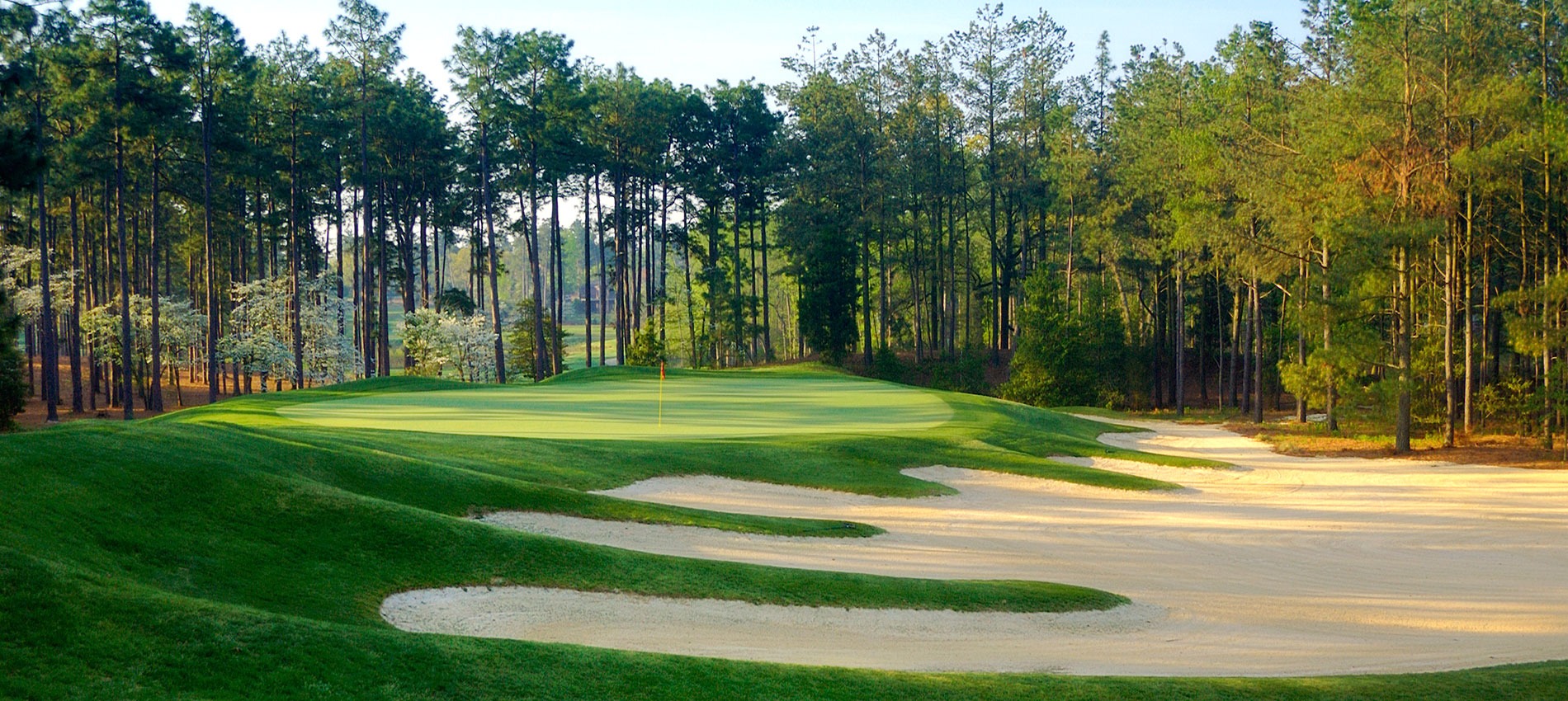
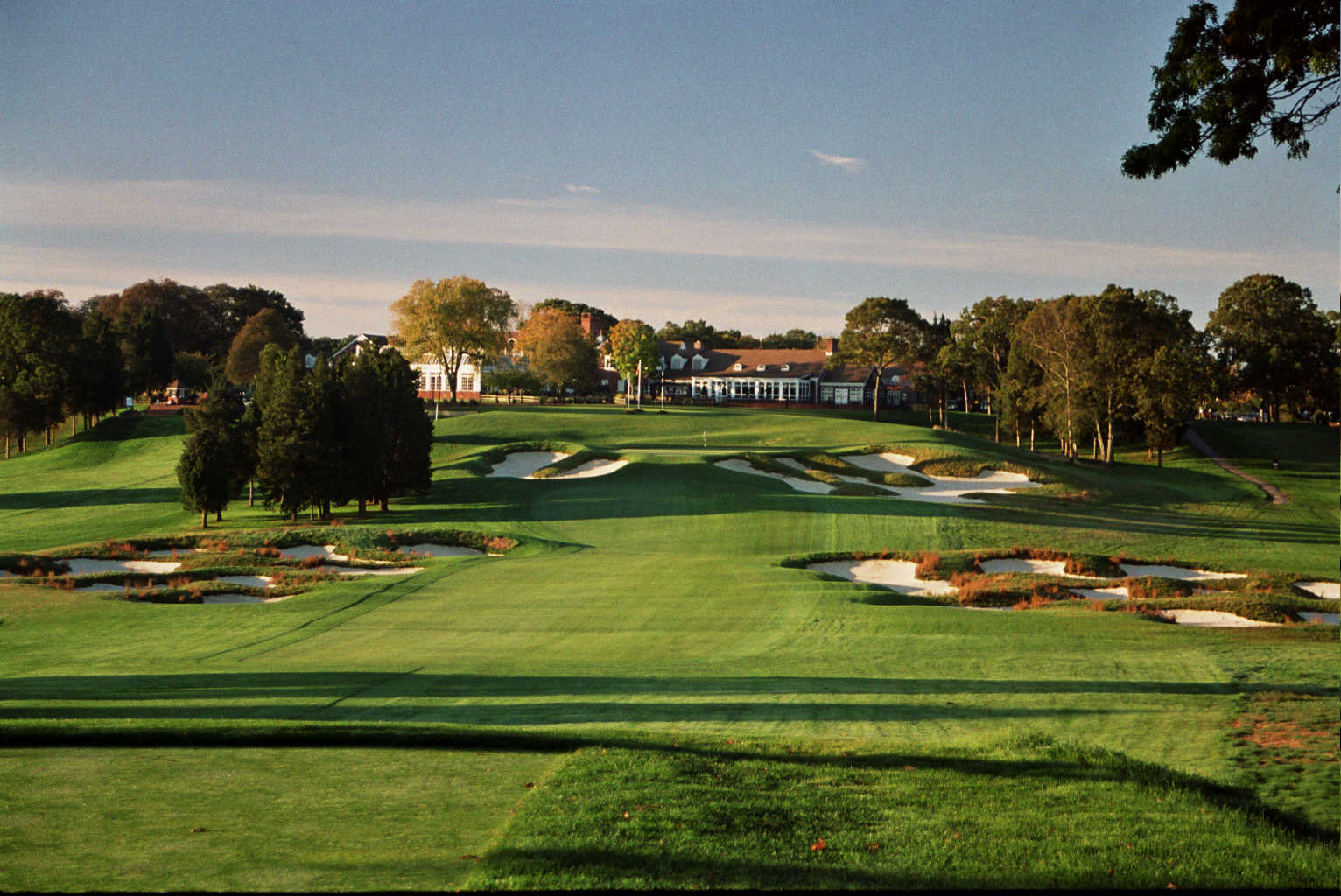
A parkland course is built inland, away from the coast, and tends to feature mature trees, lush green turf, and man-made features like dug bunkers and water hazards. Because the land wasn’t naturally suited to golf the way linksland was, parkland courses usually take far more design and maintenance work to create interest and challenge.Example of a parkland course
Augusta National, home of The Masters, is arguably the most famous parkland course in the world. Adare Manor, host of the 2027 Ryder Cup, is another example, described as one of Europe’s most immaculate parkland courses.
A private club charges initiation, monthly, and annual fees and is generally closed to the public. Overseas, though, many private clubs accept a limited number of guest rounds each week, often arranged through a member, a hotel, or a specialist golf tour operator, to help subsidize members’ costs.
A resort course typically requires players to be staying at the associated hotel property. These courses are common building blocks for a multi-stop golf trip, since access is bundled with accommodation.
Most golf travelers are booking to play full 18-hole courses. A “short course,” usually nine holes or fewer and often built around a par-3 format, is a supplementary layout resorts are increasingly building for extra quick rounds after the main course, or for an arrival-day warm-up.
A woodland course is defined by dense forest and tree-lined fairways, demanding accuracy over distance since errant shots are quickly blocked out by trees rather than just landing in rough.
Moor Park and Woburn, both in England, are frequently cited as classic examples of woodland golf, with narrow, tree-framed fairways that reward accuracy off the tee over raw distance.

The clubhouse is the main building at a golf club, housing locker rooms, restaurants, and administration offices.
The driving range is the practice facility where players warm up before a round. Not every club has one, so it’s worth checking ahead if warming up matters to you.
Most driving ranges consist of an open field lined with hitting stations, either grass or artificial turf, where golfers buy buckets of practice balls. Better-equipped ranges add a chipping area for short shots and practice bunkers for sand play alongside the range itself. Walton Heath and Swinley Forest are both examples of clubs offering this fuller setup, with dedicated chipping areas, practice nets, and putting greens alongside their main ranges.
A halfway house is a small building or hut, typically found near the turn between the 9th and 10th holes, where golfers can stop for food, drinks, or a bathroom break mid-round. Facilities range from a basic snack hut at a municipal course to a fully staffed mini-restaurant at a private club. The concept grew out of the standard 18-hole layout of two nine-hole loops returning near the clubhouse, making a permanent stop at the turn a natural fit.
The main rule of thumb is to keep the stop brief, since the group behind is usually finishing the front nine at the same time and waiting to play through. Some clubs even build a mandatory pause into their pace-of-play policy at particularly popular halfway houses.
A practice green is a separate putting surface, cut to the same height as the course’s actual greens, used to warm up before a round or work on short game shots. It’s usually positioned near the first tee so golfers can putt while waiting for their tee time, or near the driving range so a full warm-up covers both the long and short game. Some clubs also have a dedicated chipping green nearby, a slightly rougher surface surrounded by bunkers and different lies, for practicing shots played from just off the green.
The pro shop, which may sit inside the clubhouse or as a separate building, sells golf merchandise and is usually where guests check in before their round.
The 19th hole is an informal term for the clubhouse bar or restaurant where golfers gather after finishing their round, since a standard course only has 18 holes. It’s used casually rather than as an official facility name, as in “meet you at the 19th hole” after a round.
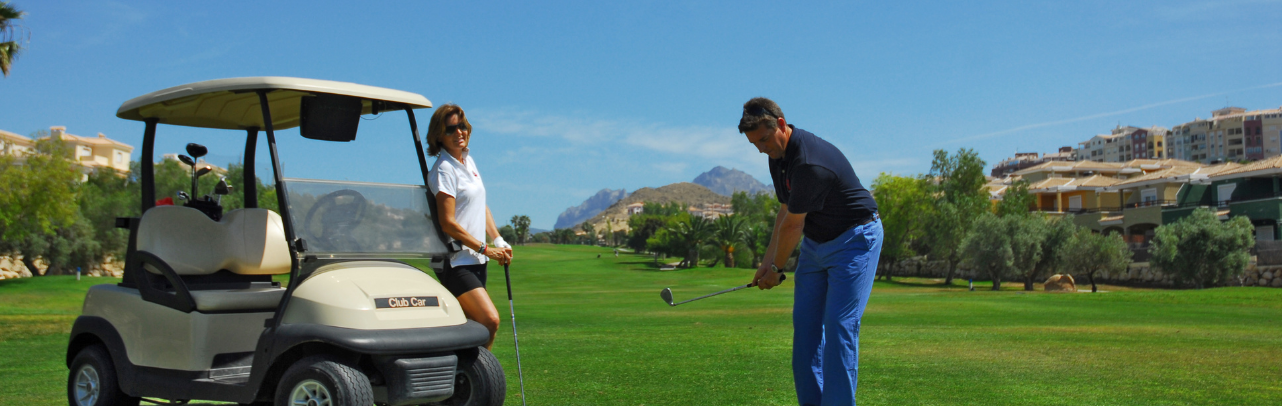
Buggie is the term used in the UK and Ireland for a gas- or battery-powered golf cart, where carts of any kind are relatively rare.
Cart is the American term for a gas- or battery-powered vehicle used to get around the course. It’s the same thing called a “buggie” in the UK and Ireland.
Most private and high-end public courses enforce a strict dress code: collared shirts, no jeans, and shorts of a specific length or style.
Private clubs tend to be the strictest, typically requiring a tucked-in collared shirt, tailored trousers or knee-length shorts, a belt, and proper golf shoes, with denim banned outright. Resort courses are usually more relaxed, still expecting a collared shirt but sometimes allowing neat denim or a wider range of shorts. Public courses tend to be the most forgiving, often accepting clean sneakers and casual athletic wear as long as it isn’t gym kit. It’s always worth checking a specific club’s policy in advance, since the rules can vary significantly even between two private clubs.
Women are generally expected to wear a collared top as well, though sleeveless collared shirts are usually accepted. A golf skirt, skort, or golf dress is a common alternative to shorts, and is accepted at most clubs that would otherwise require tailored bottoms for men.
The golf bag holds the clubs and typically has one or more shoulder straps.
A golf glove is worn on the lead hand (the left hand for a right-handed golfer) to improve grip on the club and reduce slipping, particularly in heat or humidity. Leather gloves offer the best feel but wear out faster, while synthetic gloves are more durable and better suited to wet weather. Most golfers carry a spare in their bag, since a wet or worn glove noticeably affects grip.
A headcover is a padded cover placed over a club’s head, usually the driver, fairway woods, and hybrids, to protect it from dings and scratches when clubs knock together in the bag or during travel. Headcovers are less common on irons, which are more durable, but are considered essential for a driver given how easily its face can be scuffed.
Metal spikes are essentially extinct: almost nobody wears them, and most clubs wouldn’t allow them anyway.
A pull cart is a three-wheeled frame with a handle that a golf bag sits on and is walked around the course. It’s the same thing as a push cart or trolley.
A push cart is a three-wheeled frame with a handle that a golf bag sits on and is walked around the course. It’s the same thing as a pull cart or trolley.
Certain destinations call for a waterproof rain suit, particularly in cooler, wetter golf regions.
Soft spikes are rubber or soft plastic cleats and, along with soft-soled shoes, are now the standard at almost every course.
The travel cover goes over the golf bag for airline transport. Never lock a travel cover: airline security needs to be able to open it.
A trolley is a three-wheeled frame with a handle that a golf bag sits on and is walked around the course. It’s the same thing as a pull cart or push cart.
In windy locations, umbrellas are often more of a burden than a help, and can become genuinely difficult to manage on an exposed links course.
A yardage book is a small, pre-measured guide to a golf course, giving exact distances to greens, hazards, and other key points on every hole, along with elevation changes and green details. Unlike a GPS device, which estimates distance by satellite, a yardage book’s distances are physically measured in advance, which is why professional tours still rely on them even though GPS and rangefinders are now permitted in many events. Most high-end courses sell their own yardage book in the pro shop.
A caddie carries a golfer’s bag for all 18 holes and offers distances and advice. A “double bag” caddie carries two players’ bags at once, a setup more common in the US than overseas, where single-bag caddying is closer to the norm.
Caddie tipping isn’t included in the base fee, and the fee itself barely covers a caddie’s expenses, so the tip is where most of their income comes from. A widely used rule of thumb is 30 to 50 percent of the caddie fee on top, with 40 to 50 percent standard for genuinely good service at a high-end club. When in doubt, it’s normal to ask the caddie master or pro shop staff what’s customary at that particular course before the round starts.
The caddie master runs a club’s caddie program: assigning caddies to groups, setting or communicating fees, and managing the roster of loopers available on a given day. If a golfer is unsure what to tip, or wants to request an especially experienced caddie, the caddie master is generally the right person to ask.
The club professional, sometimes called the head pro or head golf professional, oversees the day-to-day golf operation at a club: managing the pro shop, coordinating tee times and instructors, and often giving lessons themselves. At larger clubs there may be a separate director of golf overseeing multiple staff professionals. Tipping a club professional for a lesson isn’t generally expected, unlike tipping a caddie.
Course architect is another term for the person who designs a golf course, used interchangeably with course designer. See “course designer” below for well-known names and examples.
Course designer describes the person who designs a golf course, used interchangeably with course architect.
Alister Mackenzie co-designed Augusta National with Bobby Jones and also worked on Lahinch in Ireland. Harry Colt designed both Sunningdale’s New Course and Swinley Forest. Herbert Fowler designed Walton Heath. In Oregon, Tom Doak designed Pacific Dunes and Bill Coore and Ben Crenshaw designed Bandon Trails, both part of Bandon Dunes Golf Resort.
A forecaddie assists all four golfers in a group equally, without carrying anyone’s bag. They offer advice, give distances, rake bunkers, and read putts.
A marshal, also called a course ranger, patrols the course to keep pace of play moving and make sure golfers are following the rules and etiquette of the club. Marshals can help with basic rulings, locate lost balls, or call the clubhouse in an emergency, and are usually easy to spot driving a cart marked “marshal” or “ranger.” Tipping a marshal isn’t expected.
The starter is based at the first tee and manages the flow of players heading out for their round: checking golfers in, confirming tee times, and making sure each group departs in order and on schedule. It’s often the first point of contact a visiting golfer has with course staff on the day of play, and a good starter can also explain any local rules or course conditions before a group tees off.

A bunker is a hollow filled with sand, built into a course as a hazard. It is the same thing golfers casually call a “sand trap,” but bunker is the correct term. Links courses typically use small, deep “pot” bunkers, while parkland courses tend to favor larger, more sculpted bunkers.
Course rating is a number, usually shown alongside slope rating on a scorecard, such as 72.3, that represents the score a scratch golfer (a 0 handicap) is expected to shoot on that course under normal conditions. A course rating higher than par (say, 74.2 on a par-72 course) signals a genuinely tough test even for elite players, while a rating below par suggests a more forgiving layout. It’s calculated by trained raters who walk every hole and score it against dozens of factors, including hazards, green speed, and effective playing length.
Course rating and par sound similar but measure different things. Par is a fixed, theoretical number set independently of any actual scoring data. Course rating is a measured, real-world estimate of how a scratch golfer will actually score there, and the two numbers are often close, but rarely identical.
A handicap is a golfer’s average number of strokes over par. An 8-handicap player, for example, is reasonably expected to shoot around 80 on a par-72 course.
Formal handicapping developed alongside par and bogey scoring in the late 1800s and early 1900s, largely driven by Britain’s Ladies’ Golf Union, which began building a national handicapping system for women in 1893.
Since 2020, most of the world’s major handicapping bodies, including the USGA and The R&A, have used a single, unified World Handicap System, so a golfer’s handicap is portable between countries and courses rather than tied to one local system. A handicap is calculated from the average of a golfer’s best 8 score differentials out of their last 20 rounds, adjusted using that course’s rating and slope.
An index is a computer-generated number that adjusts a golfer’s handicap slightly from course to course, accounting for how difficult a specific course plays.
A handicap index is the portable number that follows a golfer between courses. A course handicap is that index converted for the specific tees being played that day, using the course’s rating and slope, and it’s the course handicap, not the raw index, that determines how many strokes a golfer actually receives in competition.
A scratch golfer is a player with a handicap index of 0.0, meaning they’re expected to play to par on an average course under normal conditions. Scratch golfers are the reference point used to calculate a course’s rating, and a “bogey golfer,” roughly a 20 handicap for men or 24 for women, is the other reference point used to calculate slope rating.
Slope rating compares the course rating (the expected score for a scratch golfer) against the bogey rating (the expected score for a bogey golfer), and the bigger the gap between the two, the higher the slope. Slope numbers run from 55 to 155, with 113 set as the baseline for standard difficulty. A course rated similarly to another for a scratch golfer can still play dramatically harder for a bogey golfer if its slope rating is significantly higher, which is exactly the situation this system was designed to correct for when it was introduced in the 1980s.
Slope is the measure of how much harder a course plays for an average golfer compared with a scratch golfer. A slope rating of 155, for instance, plays considerably harder than a rating of 125. Golfers can manage a course’s difficulty by choosing tee boxes suited to their skill level, rather than always playing from the back tees, which are typically reserved for the most skilled players.
Championship-level courses with narrow corridors, thick rough, and punishing hazards often carry slope ratings well above the 113 baseline, sometimes into the 140s from the championship tees. Walton Heath’s Old Course, stretching to 7,331 yards with small green targets, and Royal Troon, an out-and-back Open Championship links exposed to constant coastal wind, are both good examples of courses that play significantly harder than their yardage alone would suggest.
Increments describes the interval of time between each group, or “foursome,” teeing off. Most courses run 10-minute increments, for example tee times at 09:00, 09:10, and 09:20, though some use 8, 12, or 15 minutes.
Longer increments generally mean faster pace of play, since fewer players are on the course at once. Shorter increments let a course generate more revenue by fitting more groups into a day, but usually slow play down as groups catch up to one another.
Pace of play is the target time to complete a round, typically four hours for 18 holes, or 90 minutes for a short course. In practice, rounds of four and a half to five hours are common, and a good golf travel advisor can help set expectations in advance.
Group size has a direct effect on how long a round takes. As a rough guide, a twosome can expect to play in around three hours, a threesome in about three and a half, and a standard foursome in roughly four hours. Choosing tees appropriate to a golfer’s actual driving distance, rather than always playing the back tees, is one of the simplest ways a group can help keep to that pace.
Pairings are who a golfer plays with on a given day, and they typically change daily for group trips.
Playing through is when a faster group is invited to pass a slower group ahead of them on the course. Etiquette holds that if a group can’t keep pace and is holding up play behind them, it should offer to let the faster group play through at the next natural opportunity, usually a tee box or green, rather than let a gap build up over several holes. It isn’t a formal rule of golf, but it’s one of the most widely followed customs on a crowded course.
Nearly all courses have a strict no-refund rain policy: courses stay open through normal rain and only close for lightning.
Ready golf is the modern approach to playing order: whoever is ready to hit safely does so, rather than strictly following the traditional “honor” system where the player farthest from the hole, or the winner of the previous hole, always plays first. It’s widely encouraged specifically to speed up pace of play, and has become the standard recommendation at most clubs and in casual rounds, though the traditional honor system is still generally observed in formal match play and on the tee box.
Hotel roommates are arranged separately and in advance of a trip, and don’t normally affect who a golfer is paired with on the course.
A shotgun start is a format where every group in a tournament or large outing tees off simultaneously from a different hole on the course, rather than starting one after another from the first tee. A signal, traditionally a shotgun blast, now more often an air horn, sends every group out at once, and each group plays 18 holes in sequence starting from its assigned hole. It’s common at charity events, corporate outings, and multi-group golf trips, since it gets a large field on and off the course together rather than staggering start and finish times over several hours.
Start time describes the scheduled moment a group begins its round, used interchangeably with tee time.
Tee time describes the scheduled moment a group begins its round, used interchangeably with start time.

A career Grand Slam is winning all four men’s major championships, The Masters, The PGA Championship, The US Open, and The Open Championship, at any point across a golfer’s career, as opposed to winning all four in a single calendar year. Only six golfers have completed it: Gene Sarazen, Ben Hogan, Gary Player, Jack Nicklaus, Tiger Woods, and Rory McIlroy, who completed his in 2025 at The Masters after a playoff with Justin Rose. No golfer has ever won all four majors in the same calendar year, which is why that feat, a true “calendar Grand Slam,” remains golf’s rarest achievement.
The FedEx Cup is the PGA Tour’s season-long points competition, introduced in 2007, that culminates in a three-event playoff series each August. Players accumulate points throughout the season based on their finishes, with majors and marquee events worth more than standard tournaments. The field is progressively cut through the playoffs, down to the top 30 players who compete in the season-ending Tour Championship at East Lake Golf Club, where the FedEx Cup champion is crowned and awarded a multimillion-dollar bonus.
There are four major professional men’s golf tournaments each year, played from April to July: The Masters, The PGA Championship, The US Open, and The Open Championship. Winning all four in one calendar year is the Grand Slam, achieved by Gene Sarazen, Ben Hogan, Gary Player, Jack Nicklaus, and Tiger Woods, with Rory McIlroy completing the set in 2025.
The Masters is the first major of the year, played in early April, always at Augusta National Golf Club in Augusta, Georgia, a parkland course co-designed by Alister Mackenzie and Bobby Jones. The winner receives a green jacket, which must be returned to the clubhouse after a year.
The Open Championship, often called the British Open outside the UK, is the oldest of the four majors, first played in 1860. It is run by The R&A and played in late July on a rotation of true links courses. The Old Course at St Andrews has hosted The Open more often than any other venue on the rota. The winner receives the Claret Jug.
The PGA Championship is the season’s second major, played in mid-May. It is run by the PGA of America rather than the USGA, and is the only major open exclusively to professionals.
The Players Championship is held every year at TPC Sawgrass the original stadium course, and is sometimes called the “fifth major” for its strong field and large prize fund. The par-3 17th “island green” is one of the most recognizable holes in golf.
The Presidents Cup is a biennial match play team event pitting 12 American players against 12 players from an International Team representing the rest of the world outside Europe (who instead compete in the Ryder Cup). First played in 1994, it follows a similar four-day format of foursomes, four-ball, and singles matches, and is generally held in years when the Ryder Cup isn’t taking place.
The Ryder Cup is a biennial match play competition between teams of 12 professionals from the United States and Europe, played over three days of foursomes, fourball, and singles matches. The 2027 edition will be held at Adare Manor in Ireland.
The Solheim Cup is the women’s equivalent of the Ryder Cup: a biennial match play competition between teams of 12 from the United States and Europe, using the same foursomes, fourball, and singles format. It’s named after Karsten and Louise Solheim, founders of the golf equipment brand PING.
The US Open is the third major, played in mid-June. It is run by the United States Golf Association and is known for the toughest course setups of any major: narrow fairways, thick rough, and fast greens, all designed to defend par. Unlike the other majors, it uses an open qualifying system, so thousands of golfers, not just touring pros, can attempt to qualify through local and sectional events. Pebble Beach has hosted the US Open six times, more than any other course.